Mineagerie
mieagerie.com
An idle game about heat, absurd regulators, and money that actually pays out.
- Domain age
- not stated
- Visits/mo
- not stated
- Stack
- not stated
- Hosting
- 3 mo included
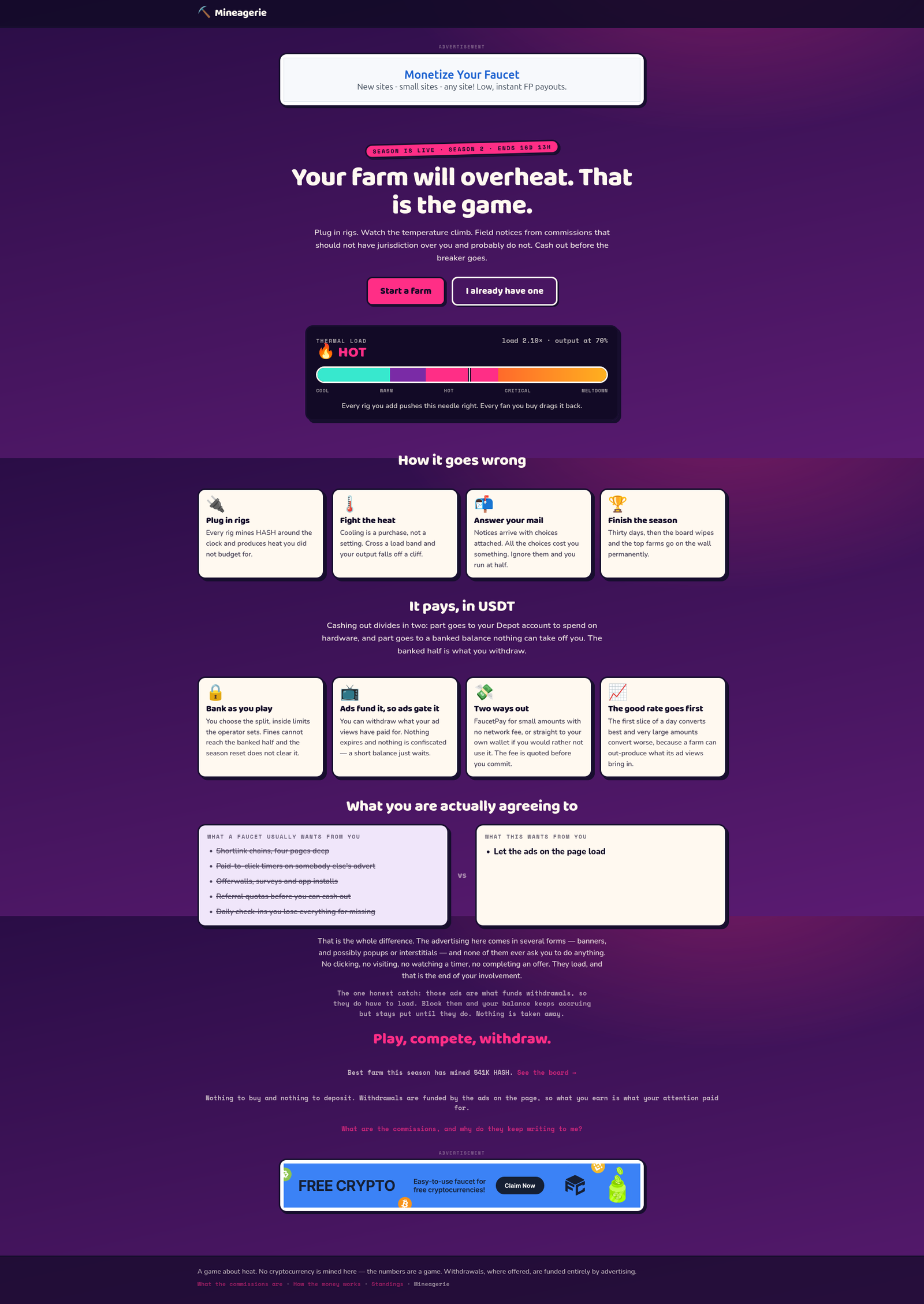
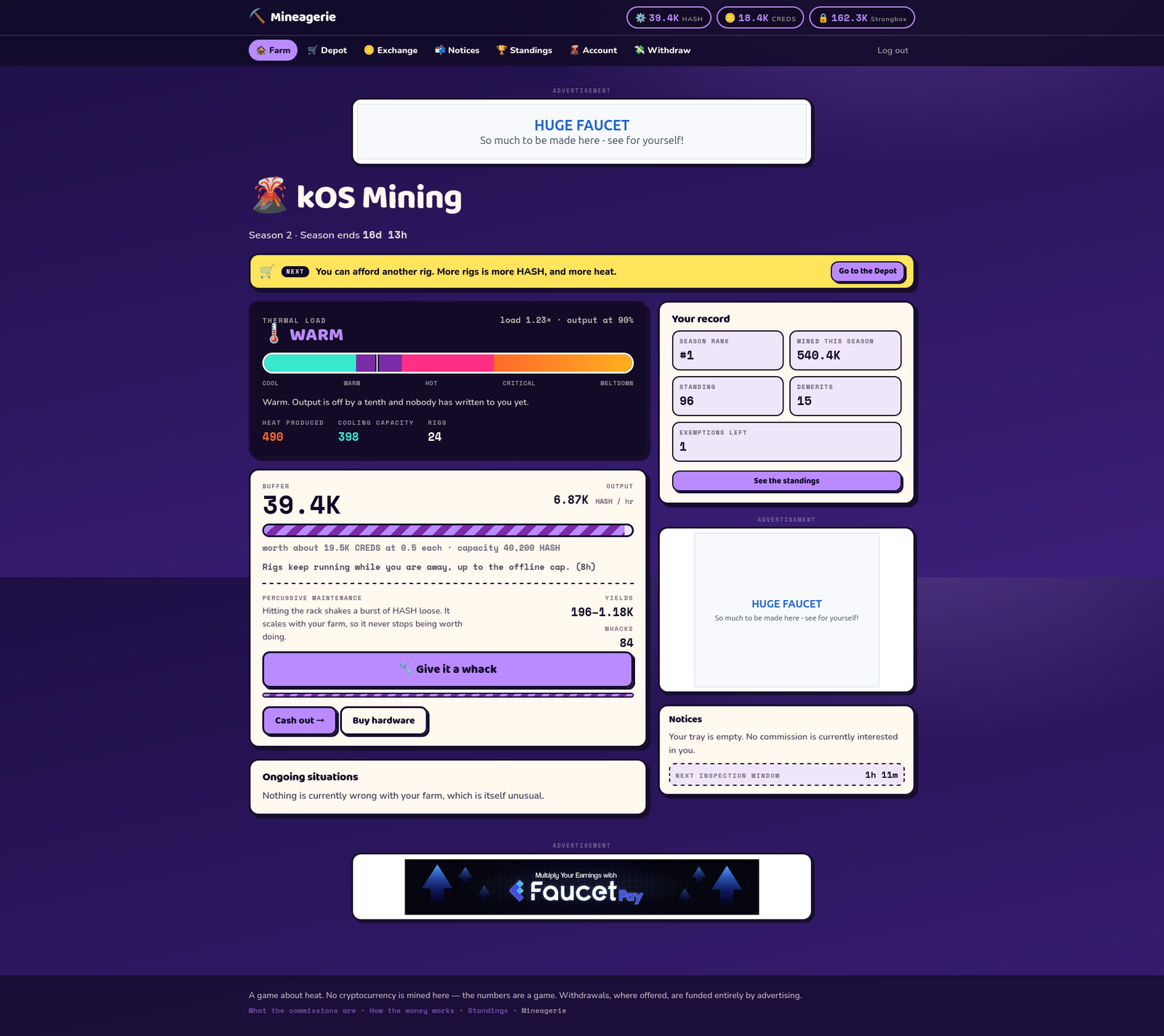
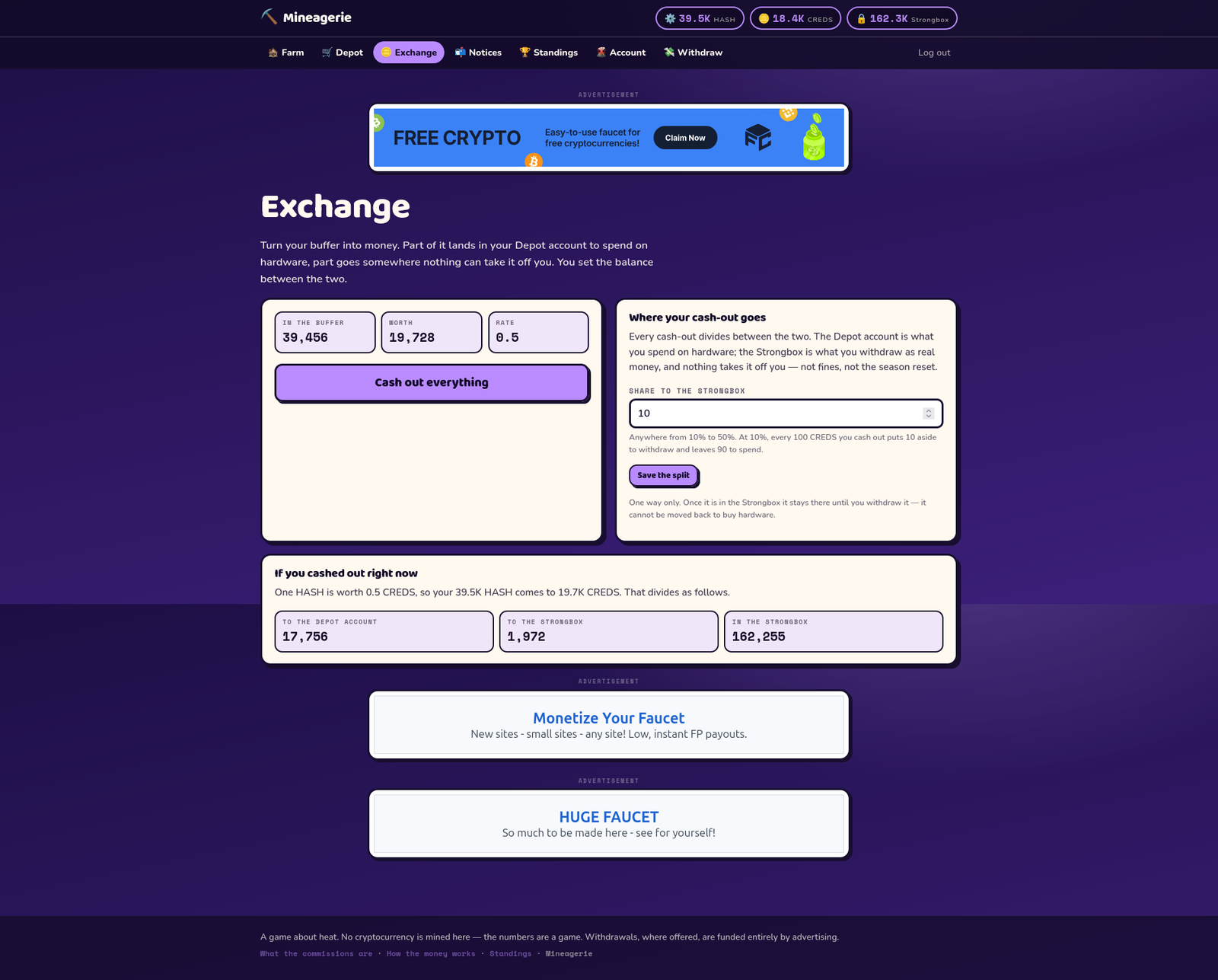
Mineagerie is a browser game with a faucet bolted on properly, rather than a faucet with a game painted over it.
Players run a crypto farm: plug in rigs, watch the heat climb, buy cooling before the thermal load throttles output to a fifth. The complication is the mail. Fourteen fictional regulators — the Bureau of Residential Load, the Provisional Council on Sunspots, the Nephew Labor Standards Division — write to players with notices that have to be answered. Most are not bills but decisions with two or three ways out, all of which cost something different. Ignore one and the whole farm runs at half output until it is dealt with.
That is the retention mechanic. Nobody comes back to watch a number rise; they come back to find out what the Thermal Compliance Board has accused them of this week.
Seasons run 30 days. At the end the board wipes, the top farms go on the Hall of Fame permanently, and everyone restarts level — but banked balances survive untouched, so nobody loses money to the reset.
On the payouts. Cashing out divides between a spendable Depot balance and a banked Strongbox balance, with the player choosing the split inside limits the operator sets. Only the banked half is withdrawable, which turns "grow the farm or take the money" into the game's central decision instead of a foregone conclusion. Withdrawals go out in USDT either through the FaucetPay API — automatically, from your faucet balance, with no human in the loop — or as a direct on-chain send for players who will not use FaucetPay. Fees are per method, quoted to the player before they commit, and deducted from their payout.
On the economics. Withdrawing requires verified ad impressions, so the site cannot pay out more attention than it received. A tiered payout schedule, a rolling 24-hour cap and the banking split all exist to keep payouts below ad revenue, and the balance between them was modelled rather than guessed — the simulation scripts are included so a buyer can re-run them against their own CPM.
What the buyer gets
The game
Ten rig tiers and six cooling tiers, all editable from admin without touching code
Five-band thermal system that throttles output as heat outruns cooling
"Percussive maintenance" — a cooldown-gated action that rolls a payout inside a band you set, giving the game an active pull without out-earning the rigs
30-day seasons with automatic rollover, a permanent Hall of Fame and a full reset that leaves banked money alone
No cron jobs anywhere. Everything time-based happens on page load, which is what makes it work on cheap shared hosting
The content
100 notices across 14 commissions, gated by farm size and heat so a small farm and a large one get different mail
Three resolution types: single acknowledgement, a choice between costed options, and timed notices that cannot be cleared until a clock runs out
New notices are added through an admin form, not a code change — the buyer can extend the library themselves
The money
USDT payouts by FaucetPay API (automatic) or direct on-chain send (manual)
Per-method fees and minimums, quoted before the player commits
Verified ad impressions gate withdrawals; a 24-hour cap and tiered rates bound exposure
Unpayable fines become debt, settled out of future cash-outs — so the penalty half of the game cannot be dodged by spending down to nothing
Ad slots are database rows: the buyer pastes their own codes in admin, and empty slots render nothing at all
Accounts and security
Email verification, password reset, Cloudflare Turnstile on signup, login and reset
Two-factor authentication for players and for admins, TOTP with QR enrolment and single-use recovery codes
Login throttling per IP and per account name
Payout addresses held on the account page with a 24-hour blackout after any change, which is the standard defence against account takeover
Signup and last-seen IPs stored as salted hashes, with an admin view of accounts sharing a connection and an optional per-IP signup cap
Admin
Dashboard, notice library editor, hardware editor, player CRUD, payout queue, ad slots, seasons, and ~70 settings grouped by subject
Per-farm reset that returns an account to a brand new signup state
FaucetPay connection tester that prints the raw API balance, so the amount multiplier can be verified against a real account before automatic payment is switched on
Presentation and SEO
Unique titles and meta descriptions per page, canonical, Open Graph, Twitter cards and JSON-LD
Dynamic robots.txt and sitemap that follow the buyer's own domain from one setting
Favicon, touch icon and a 1200x630 share image
A public page explaining the whole HASH → CREDS → Strongbox → USDT chain with live figures pulled from settings, so it can never state a rate the site is not running
Technical
PHP 8.0+ and MySQL 5.7 / MariaDB 10.3+
No Composer, no build step, no cron, no queue, no external services beyond the ones the buyer chooses to enable
20 numbered SQL migrations, run in order
Every user-facing string lives in one file, so the whole voice of the site can be rewritten without touching templates
Installs by FTP: import the migrations, fill in one config file, upload
Included in the bundle
The mineagerie.com domain
Full source, unencoded, no licence check, no callbacks
90 days of basic hosting — enough to configure, modify, test and open the site, after which the buyer should move it to a production environment
The economy simulation scripts
README and a development plan documenting what is done and what is not
Honest disclosures
These belong in the listing. A buyer who finds them out afterwards is a refund request; a buyer who reads them first is a buyer who trusts the rest of the page.
Payouts ship switched off. The buyer turns them on when they are ready.
FaucetPay needs the buyer's own API key, and the amount multiplier must be confirmed with the built-in tester before automatic payment is enabled. This is documented in the admin panel and the README.
The payout rates are the buyer's to set. Defaults are modelled on an estimated $0.20 CPM. If real CPM comes in lower, the rates need raising — the included simulation shows exactly by how much.
The notice library is finite. A hundred notices is a lot, and it is also something a dedicated player will eventually work through. Adding more is a form in the admin panel, not a code change, but it is work the buyer inherits.
Direct on-chain withdrawals are paid by hand. Only FaucetPay is automated.