Free Miners Club
freeminers.club
The hopper fills, then it stops. That's why they come back.
- Domain age
- not stated
- Visits/mo
- not stated
- Stack
- PHP 8.1+ / MySQL
- Hosting
- 3 mo included


What it is
Users get a mining rig. It produces credits around the clock into a hopper. When the hopper fills, it stops producing. That single rule is the whole product: it gives people a reason to come back every day without a single notification, and it makes daily activity a function of design rather than nagging.
Fuel is what keeps a rig running, and fuel is only issued for something that earns the site money — a timed claim, a shortlink, an advert. So every credit that leaves the site is backed by a revenue event by construction, not by hope. Credits convert to LTC and pay out through FaucetPay.
Why this isn't another faucet script
Most faucet scripts on the market are the same 2017 codebase with a new stylesheet. This was written from scratch, and four decisions in it are the difference between a site that runs itself and a site that eats your weekends.
Accrual has no cron. A rig's output is computed from three columns whenever it's read. No scheduled job walks the user table. A user idle for six months costs nothing and computes correctly the moment they return, so growth in user count costs you almost nothing.
Money is integer-only, end to end. Credits are integers and sub-credit precision lives in micro-credits, so no float ever touches the ledger. Balances are never written without a matching ledger row in the same transaction, and the admin panel continuously reconciles the two and warns you if anything ever bypasses it.
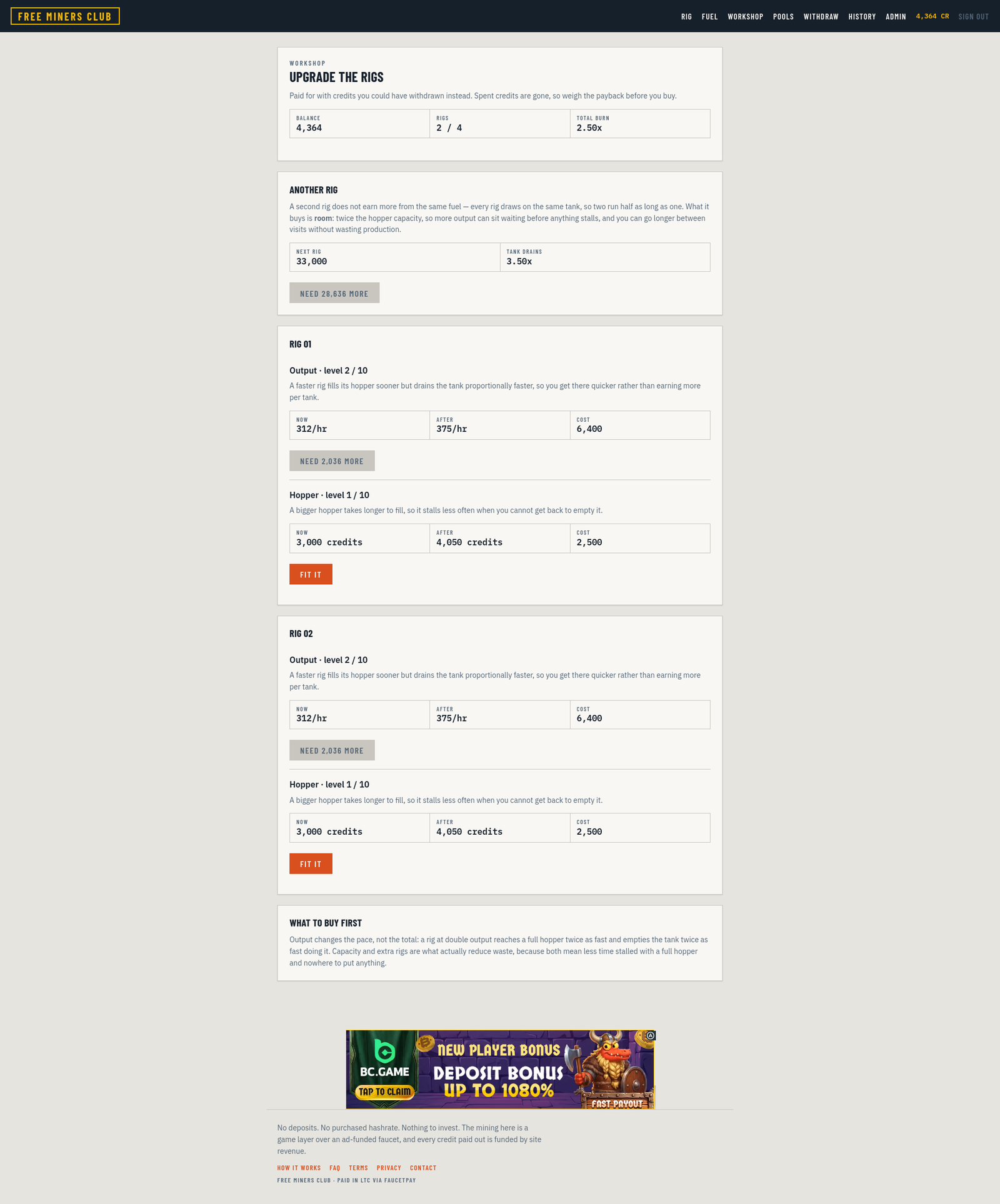
The economy can't be broken by its own upgrades. Extra rigs and output upgrades are emission-neutral by design: every rig on an account draws from one shared fuel pool, so two rigs run half as long as one. Total payout stays tied to revenue no matter how far players progress. This is tested, not asserted.
Payout failures are handled, not assumed away. A refused FaucetPay send leaves the withdrawal pending with the provider's own reason attached, attempts counted, and retryable. Nothing is ever silently lost.
The mining loop
Idle accrual that runs whether or not the site is open. Capacity-capped hoppers that stall when full. A shared fuel pool per account, drained by every running rig. Sub-credit remainders stay in the hopper so nothing is lost to rounding. Live gauges that tick in real time without polling the server. Collapsible rig cards that still show fill, credits and status when closed. Collection per rig or all at once.
Fuel sources
Timed claim on a configurable cooldown. Shortlinks that are provider-agnostic — any service accepting a return URL works through placeholder substitution, so you are never locked to one provider. Paid-to-click adverts with server-verified watch timers.
Every source has its own fuel reward, revenue figure, minimum dwell time and daily cap. Runs use single-use tokens, bound to one account, expiring, one open at a time. A single fuel page acts as the hub, showing each source, what it's worth, and what's left today. Adding a new source type is one function call — the accrual model doesn't change.
Progression
Output and hopper upgrades with a configurable level ceiling and geometric cost curves. Up to a configurable number of rigs per account, each with its own hopper and upgrade levels. Everything is bought with withdrawable credits, so every purchase is a credit sink that permanently reduces your liability.
Mining pools
Users create or join pools, with invite codes, member caps, and open or invite-only entry. A live leaderboard and per-member scoring. The prize is a fixed budget per period, not a rate — the cost never scales with the number of users or pools. Scores stay with the pool they were earned in, so pool-hopping gains nothing. Ownership passes on automatically when an owner leaves, and admin can rename, clear a motto or hide a pool.
Members recruit for their own pool, which is referral growth that doesn't feel like a referral programme.
Payouts
FaucetPay integration, automatic or manual approval, with the faucet balance visible in the panel. Withdrawals debit on request rather than approval, so nobody can queue several payouts against one balance, and rejections refund automatically with their own ledger row. Configurable minimum withdrawal, a minimum-activity gate before a first payout, and a dust guard against sub-satoshi sends.
Abuse handling
One payout address per account, enforced at the database level. IP reputation through proxycheck or ip-api — both have free tiers — cached and failing open, so a provider outage never locks your users out. Optional browser fingerprinting. Weighted risk scoring with every contributing reason recorded in plain text, because the right answer is often "a family shares a laptop."
Risky payouts are held: the withdrawal stays pending, never touches the balance, and cannot be sent by any path until a human clears it. There's a full review queue with the evidence attached and clear, flag or ban. Per-address rate limiting on sign-in and sign-up, and Cloudflare Turnstile on sign-in, sign-up, password reset and the contact form.
Accounts and security
Password recovery with single-use expiring tokens where only a hash is stored, and a request form that cannot be used to enumerate accounts. Admin two-step sign-in via TOTP with eight single-use backup codes. CSRF protection on every form and prepared statements throughout.
Admin panel
Thirteen pages. Economy shows revenue against payouts as a percentage, credits collected and paid, your real liability, a continuous ledger reconciliation check, a shared-IP report, upgrade burn and rig level spread. Settings exposes 67 tunable values — nothing about the economy requires a code edit.
Also: a payout queue with failure reasons and holds, full CRUD for fuel sources and adverts with completion and abandon counts, pool standings and settlement, the risk review queue, account search with credit adjustments and flag/ban, two-step sign-in setup, backups, a health check, preview access, and a one-click migration runner for future upgrades.
Read-only preview access
One reserved account that reads the entire admin panel and can change nothing. Every write is refused at the server, and all identifying data is masked: usernames become placeholders, payout addresses and emails are truncated, IP addresses drop to their network, fingerprints are hidden, and account search is disabled.
It stays useful after the sale. Show the panel to a prospective admin hire, an investor or a partner without exposing your users or your figures. Optional expiry date, and an optional read-only database user if you want the guarantee enforced by the database rather than by the code.
Backups and health
Backups are written in PHP, because mysqldump and shell access are usually unavailable on shared hosting. Gzipped, auto-pruned, downloadable through the panel, blocked in preview mode, with restore instructions in the docs.
The health check covers PHP version and extensions, PHP and MySQL clock agreement, pending migrations, ledger reconciliation, a leftover installer, config permissions, FaucetPay reachability, mail configuration, Turnstile, admin two-step, backups and legal page review. It also tests directory protection with a real HTTP request to your own site, because .htaccess only works if the web server reads it and plenty don't. It tells you rather than assuming.
Public site
Landing page, How It Works, FAQ, Terms, Privacy and a contact form. A 404 page, favicon and ICO, Open Graph image, meta tags, a robots.txt written at install with your real sitemap URL, and an XML sitemap. Three raw-HTML ad slots in the header, rig page and footer. Mobile-first responsive throughout, with reduced-motion preferences respected.
Under the hood
100 PHP files, roughly 8,850 lines. 21 database tables. 9 migrations with a one-click runner. 67 configurable settings. 465 test assertions across 8 suites. Around 8,100 words of documentation. No third-party dependencies, no Composer, no build step, no cron jobs, no shell access required.
Requires only PDO MySQL and cURL. Deliberately does not require mbstring, since that isn't guaranteed on shared hosting.
What you get
The complete source ready to upload, and a web installer — create a database, fill in a form, delete the installer. Nine migrations with a panel-based runner for future upgrades. A README covering every feature and setting along with the reasoning behind the economy, an OPERATIONS guide with a first-week checklist, a tuning order and a failure playbook, and a full changelog.
All eight test suites come with it, so you can verify the accrual maths, payout paths, abuse scoring and pool settlement yourself against a scratch database. There's also a FaucetPay API stub, so you can exercise the entire payout path without touching real coin. The domain transfers with the sale. [SUPPORT TERMS]
What you supply
Hosting on any shared host with PHP 8.1 or newer and MySQL, plus a FaucetPay account. Your own ad network and shortlink provider accounts. A Cloudflare account if you want Turnstile, where the free tier is fine. And a legal review of the Terms and Privacy pages — they ship as a considered starting point rather than legal advice, and the panel reminds you until you've reviewed them.
Offerwalls are deliberately not included. Most new faucets can't qualify for offerwall access any more, so the plumbing would sit unused. Adding one later is the same small job as any other fuel source.
Look before you buy
Ask and you'll get read-only panel access to the live site: real numbers, real activity, every user detail masked. You can see the economy panel, the payout history, the fuel source performance and the health check before you spend anything. I'd rather you look than take my word for it.
Straight talk
Faucet revenue is small and it's work. This is a well-built site with an honest economy, not a passive income machine. What you earn depends on the ad and shortlink rates you can negotiate and the traffic you can bring. The software makes the mechanics reliable; it does not make the market generous.
You have to set the revenue figures honestly. The economy panel tells you whether you're paying out more than you earn — but only if you enter what your fuel sources actually pay. Guess, and the panel will confidently tell you a comfortable lie.
Multi-accounting is the permanent problem. The abuse tooling here is genuinely good and it will not be perfect, because shortlink and advert verification cannot prove a human looked at a page. Daily caps are what bound your loss. Set caps you could afford to see fully abused.
It is not cloud mining, and the site says so. The public copy states plainly that there are no deposits, no purchased hashrate and nothing to invest. Keep that language. It's what separates this from the pile of HYIP scripts it would otherwise be sorted with, and it's why users trust a payout.
How it earns now
Not yet monetised. The ad slots and fuel sources are configured by the buyer with their own ad network and shortlink accounts, which is why the price reflects the build rather than an earnings multiple. The site is live and taking registrations, so you inherit users and traffic rather than an empty install.